Magic Mushrooms (Psilocybin): Benefits, Risks, Safety, and What Cannabis Consumers Should Know
Interest in psychedelics is growing rapidly — especially among cannabis consumers who are already familiar with plant-based substances. Magic mushrooms (commonly called shrooms) contain psilocybin, a naturally occurring psychedelic compound that alters perception, mood, and cognition.
At Dank Mart, we believe education comes first. Whether you’re exploring cannabis, learning about emerging psychedelic research, or simply curious about how these substances compare, understanding both the potential benefits and risks is essential.
But are dried shrooms safe?
What are the real benefits and risks?
How do they compare to cannabis?
And what should consumers know about legality, drug testing, and safety?
This comprehensive guide breaks down the science, risks, cultural context, and practical considerations — especially for readers in the cannabis community seeking trustworthy, education-first information.
What Are Magic Mushrooms?
Magic mushrooms are fungi containing psilocybin, which converts in the body into psilocin. Psilocin interacts primarily with serotonin (5-HT2A) receptors, producing altered sensory perception, emotional shifts, and changes in thought patterns.
Common species include:
- Psilocybe cubensis (most widely known)
- Enigma mushroom (a potent mutation of cubensis)
- Psilocybe caerulipes (“blue-foot,” native to parts of North America)
Potency varies significantly by species, growing conditions, and preparation — making dosing unpredictable compared to regulated cannabis products.
How Do Shrooms Affect the Brain?
Psilocybin temporarily alters activity in brain regions linked to:
- Self-referential thinking (default mode network)
- Emotional processing
- Sensory integration
- Pattern recognition
Users commonly report:
- Visual distortions or enhanced colors
- Time distortion
- Deep emotional reflection
- Increased introspection
- Heightened sensory awareness
- Spiritual or existential insights
Unlike cannabis — which primarily influences the endocannabinoid system — psilocybin acts on serotonin pathways, resulting in a fundamentally different psychological experience.
Potential Benefits of Psilocybin (Based on Research)
It’s important to distinguish between:
- Clinical research settings
- Recreational or unsupervised use
Most promising benefits have been observed in controlled therapeutic environments.
1. Depression Relief
Several modern clinical studies have found psilocybin-assisted therapy may reduce symptoms of major depressive disorder.
Participants in structured therapy sessions have shown:
- Significant symptom reduction
- Increased emotional openness
- Long-term mood improvements after guided sessions
Important: These results occurred under medical supervision with psychological support — not casual use.
2. Anxiety Reduction (Including End-of-Life Distress)
Research involving patients facing terminal illness has shown psilocybin may reduce:
- Death anxiety
- Existential distress
- Emotional avoidance
Many participants reported lasting shifts in perspective and acceptance.
3. Addiction Support
Preliminary research suggests psilocybin may support recovery from:
- Nicotine dependence
- Alcohol use disorder
- Certain behavioral addictions
The proposed mechanism involves disruption of rigid thought patterns and increased cognitive flexibility.
4. Increased Emotional Processing
Many users report:
- Greater empathy
- Emotional breakthroughs
- Improved self-awareness
However, emotional intensity can also be overwhelming.
The Real Risks of Using Shrooms
While media coverage often highlights potential benefits, risks are real — particularly outside clinical settings.
1. Bad Trips
A “bad trip” refers to intense psychological distress during a psychedelic experience.
Symptoms may include:
- Panic
- Paranoia
- Fear of losing control
- Confusion
- Emotional overwhelm
Unlike cannabis anxiety (which often resolves as THC levels drop), a psilocybin experience can last 4–6 hours, making distress more prolonged.
2. Triggering Psychosis
People with:
- Schizophrenia
- Bipolar disorder
- Family history of psychotic disorders
may face increased risk of adverse mental health reactions.
This is one of the most serious concerns with psychedelic use.
3. Hallucinogen Persisting Perception Disorder (HPPD)
Rarely, individuals report persistent visual disturbances such as:
- Visual snow
- Trails behind moving objects
- Light sensitivity
While uncommon, it is a documented risk.
4. Physical Side Effects
Common physical effects include:
- Nausea
- Vomiting
- Increased heart rate
- Sweating
- Dizziness
Unlike cannabis, psilocybin frequently causes gastrointestinal discomfort.
5. Legal Risks
In most U.S. states, psilocybin remains federally illegal.
Some cities and states have decriminalized possession, but:
- Distribution remains illegal in most areas.
- Federal law still classifies psilocybin as Schedule I.
Cannabis legalization does NOT automatically mean psychedelics are legal in the same jurisdiction.
Always verify local laws.
Do Shrooms Show Up on a Drug Test?
This is one of the most searched questions.
Standard 5-Panel Drug Tests
These typically test for:
- THC
- Cocaine
- Amphetamines
- Opiates
- PCP
Psilocybin is NOT included.
Specialized Tests
More advanced testing can detect psilocybin or psilocin in urine for:
- 24–48 hours (typically)
- Rare cases slightly longer
Hair testing is possible but extremely uncommon.
How Long Do Shrooms Stay in Your System?
Psilocybin is metabolized quickly.
- Effects begin: 20–60 minutes
- Peak effects: 2–3 hours
- Total experience: 4–6 hours
- Detectable in urine: usually under 48 hours
This is significantly shorter than THC, which can remain detectable for days or weeks depending on usage frequency.
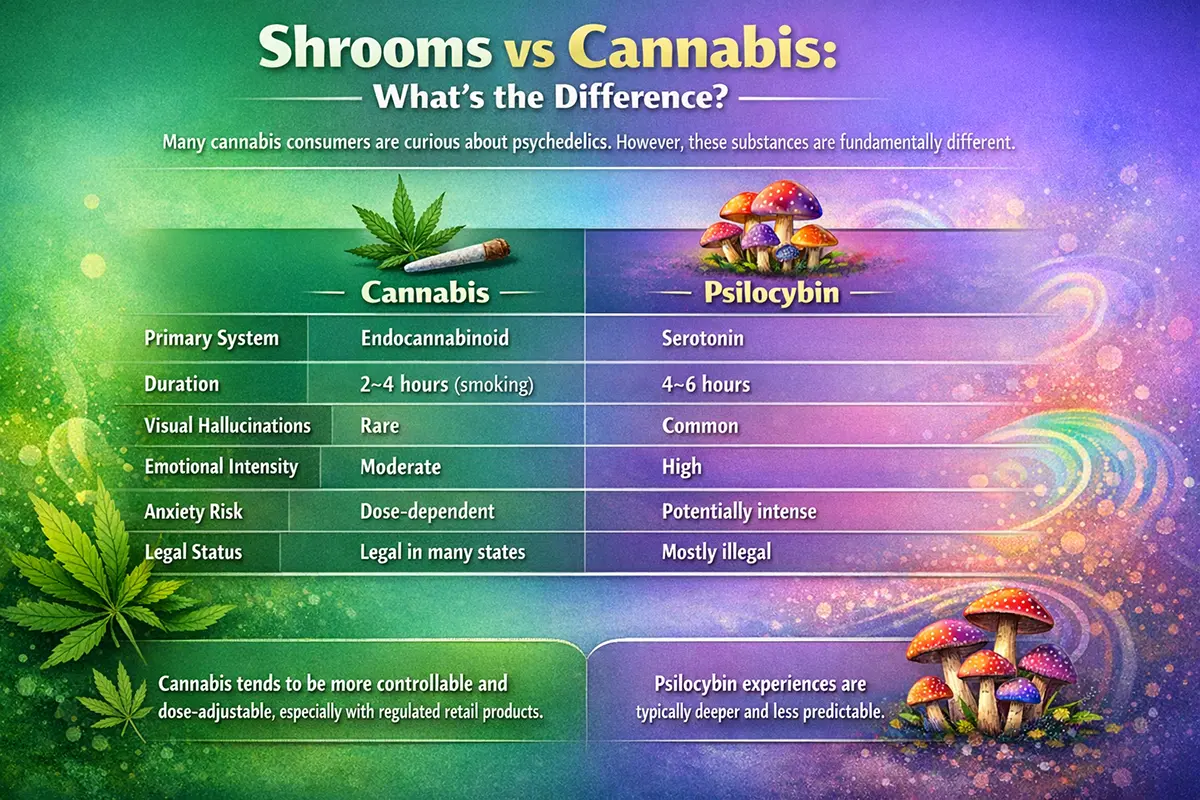
Shrooms vs Cannabis: What’s the Difference?
Many cannabis consumers are curious about psychedelics. However, these substances are fundamentally different.
| Feature | Cannabis | Psilocybin |
| Primary System | Endocannabinoid | Serotonin |
| Duration | 2–4 hours (smoking) | 4–6 hours |
| Visual Hallucinations | Rare | Common |
| Emotional Intensity | Moderate | High |
| Anxiety Risk | Dose-dependent | Potentially intense |
| Legal Status | Legal in many states | Mostly illegal |
Cannabis tends to be more controllable and dose-adjustable, especially with regulated retail products.
Psilocybin experiences are typically deeper and less predictable.
Microdosing: Trend or Therapy?
Microdosing refers to consuming very small amounts of psilocybin — typically below perceptual levels.
Reported goals include:
- Increased focus
- Enhanced creativity
- Mood stabilization
However:
- Research is still limited.
- Placebo-controlled trials show mixed results.
- Dosing precision is difficult with unregulated products.
Compared to cannabis microdosing (e.g., 2.5mg THC edibles), psilocybin microdosing is far less standardized.
Who Should Avoid Shrooms?
Psilocybin is NOT recommended for:
- Individuals with psychotic disorders
- Those with bipolar disorder
- Pregnant individuals
- People on SSRIs, MAOIs, or lithium
- Individuals with cardiovascular issues
- Anyone in unstable emotional states
If someone is experiencing active depression with suicidal ideation, unsupervised psychedelic use can worsen distress.
Harm Reduction Guidelines
If someone chooses to experiment despite risks, safer-use practices include:
- Start with a low dose
- Avoid mixing with alcohol or stimulants
- Use in a calm, safe environment
- Have a trusted, sober sitter present
- Avoid driving or risky environments
- Never consume unidentified wild mushrooms
Misidentification of wild mushrooms can be fatal.
Psychedelics and Modern Culture
Interest in psychedelics has expanded due to:
- Clinical research coverage
- Mental health conversations
- Wellness influencers
- Decriminalization efforts
However, commercial hype often outpaces scientific consensus.
As with early cannabis legalization days, misinformation spreads quickly — making reliable education essential.
Cannabis Consumers Exploring Psychedelics: Important Considerations
Many cannabis consumers assume psychedelic experiences will feel similar to high-dose THC.
They are not.
Key differences:
- Psilocybin is far more immersive.
- Emotional experiences can feel unavoidable.
- There is less “control” once effects begin.
- Dose titration is difficult.
Consumers comfortable with 25mg THC edibles may still find moderate psilocybin overwhelming.
Are Shrooms Addictive?
Psilocybin is not considered physically addictive.
However:
- Psychological attachment to profound experiences is possible.
- Frequent use can diminish psychological integration benefits.
Unlike cannabis, daily use of psilocybin is uncommon due to rapid tolerance buildup.
The Future of Psilocybin Research
Ongoing studies are exploring use in:
- PTSD
- Treatment-resistant depression
- Cluster headaches
- OCD
- Substance use disorders
Regulated psychedelic therapy may expand in coming years, similar to how cannabis transitioned from prohibition to medical legalization.
Final Thoughts: Education First
Magic mushrooms are powerful psychoactive substances.
They show promise in controlled clinical environments — but also carry real psychological and legal risks.
For cannabis consumers exploring plant-based wellness, the most important step is staying informed. Psychedelics are not simply “stronger cannabis” — they operate differently in the brain and can produce far more intense psychological experiences.
At DankMart.co, our goal is to provide clear, balanced education so you can make informed decisions about cannabis and emerging plant-based substances. Responsible consumption starts with knowledge, safety, and respect for the risks involved.
Stay curious — but stay informed.
Frequently Asked Questions
Are shrooms safer than cannabis?
Not necessarily. Cannabis generally has a lower risk of triggering intense psychological episodes.
Can you overdose on shrooms?
Fatal overdose is extremely rare, but psychological distress and unsafe behavior can occur.
Do shrooms cause brain damage?
Current research does not show neurotoxicity in controlled use, but long-term unsupervised effects remain under study.
Can you mix cannabis and shrooms?
Mixing substances increases unpredictability and intensity. It significantly raises anxiety risk.
References:
Johnson, J. Medically reviewed by D. O’Carroll, MD. (2024, August 23). How long do ‘magic mushrooms’ stay in your system. Medical News Today. Available At: https://www.medicalnewstoday.com/articles/how-long-do-shrooms-stay-in-your-system
Grey, K, L. Medically reviewed by F. Aremu, PharmD. (2020, November 29). Mushrooms and Cannabis: How They Compare and Interact. Healthline. Available at: https://www.healthline.com/health/substance-use/shrooms-and-weed#cannabis-vs-mushrooms
Peter G., MD. (2022, September 19). The popularity of microdosing of psychedelics: What does the science say?. Available at: https://www.health.harvard.edu/blog/the-popularity-of-microdosing-of-psychedelics-what-does-the-science-say-202209192819
Dr. Louisa Degenhardt, Ph.D, AO, FAA, FASSA, FAHMS

About author




Add comment